
There has been a sharp slowdown in revenue and profit growth in the cement sector in recent quarters but it is yet to show in the share prices of cement companies. On the contrary, there has been a rally in cement stocks and a re-rating of their equity valuation in the past three years despite an earnings contraction during the period.

Domestic institutional investors (DIIs) have infused a record Rs 4.6 trillion into Indian equities over the course of Samvat 2080, marking the highest net annual investment in any Samvat to date. This robust domestic inflow has effectively counterbalanced the comparatively subdued investments from foreign portfolio investors (FPIs), who contributed a net Rs 90,956 crore within the same timeframe. Against this backdrop, the Nifty 50 and BSE Sensex indices are on track to achieve their best performance in three Samvat years, despite recent market corrections.
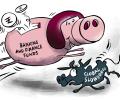
Companies in the banking, finance sector and insurance (BFSI) sector have underperformed on the bourses despite leading the earnings growth charts in the post-pandemic period. This has created a dichotomy between their earnings and share prices. BFSI companies have never been less expensive than the rest of the equity market.

Shares of healthcare services major Max Healthcare Institute have gained over 23 per cent since the start of this month and the stock crossed the Rs 1 trillion mark on September 24. On September 25, it closed 989.85 apiece at the NSE. The gains were cornered on the back of a strong outlook for the sector and aggressive expansion plans for the chain led by acquisitions and organic growth.

India's financial sector is dominated by large government-owned and private-sector banks.

In calendar year 2024, the stock price of Trent has zoomed 160% As compared to the 18% rally in the BSE Sensex during the same period. It has outperformed the market in the past 10 consecutive years.

The last four years, the best for corporate profits in a long time, have not been as impressive for corporate capital expenditure. The combined net profits of India's top listed companies excluding banks, financial services, and insurance (BFSI) increased at a compound annual growth rate (CAGR) of 32.4 per cent since FY20, a sharp jump from the 7.4 per cent in corporate earnings between FY14 and FY19.

A sharp rise can be attributed to the significant changes in India's share buyback tax regime, which will come into effect from October 1, 2024.

After four years of high double-digit growth in profits, corporate earnings of Indian companies hit a speed bump in the April-June quarter of 2024 (Q1FY25), leading to the risk of a downward revision in India Inc profit estimates for FY25 and volatility in the equity market. Earnings growth slowed despite companies in most non-financial sectors reporting higher operating margins from lower commodity prices and a decline in interest costs.

'India's top companies currently lack the organisational wherewithal to hire and train 2 million interns annually, given their current scale of operations and existing employee base.'
India Inc has reported a muted start to the financial year 2024-25, with a decline in net earnings and a modest single-digit uptick in revenues. An analysis of 488 companies that have released their results for the June 2024 quarter reveals a 1.6 per cent year-on-year (Y-o-Y) drop in combined net profit -- the weakest performance in the past seven quarters. In stark contrast, the combined net profit of these companies experienced a 13.6 per cent Y-o-Y increase in the previous quarter (Q4FY24) and a 65.2 per cent Y-o-Y rise in Q1FY24.

The early-bird results for the April-June quarter of 2024 (Q1FY25) hint at a slowdown in corporate revenues and profits in FY25. Corporate profits might face headwinds from a continued revenue growth slowdown and a reversal in margin gains from lower commodity and energy prices in FY24. The combined net profit (adjusted for exceptional gains and losses) of the 210 companies that have declared their Q1FY25 results so far is down 4.2 per cent from the year-ago period - their worst showing in seven quarters.

The Budget proposals are expected to boost the fortunes of consumer goods and fast-moving consumer goods companies, which have been struggling with poor consumer demand for more than a year. The Budget announcements, such as the increase in standard deduction by Rs 25,000 for income-tax payers and slab revisions, will put more money in their hands, boosting consumer demand. Private consumption is also likely to benefit from a new scheme to offer internships to 10 million youths in the country's top 500 companies.

Ultratech Cement's acquisition of a 23 per cent stake in Tamil Nadu-based India Cements is another instance of growing consolidation in the cement market in India. The deal will raise Ultratech's share, based on India Cements' revenues in FY24, in the domestic market by 230 basis points if the latter is formally acquired by the former in due course. India Cements' share was up 11.5 per cent on Thursday on market expectations of an open offer.

Domestic institutional investors pumped Rs 2.3 trillion into equities during H1 CY24. Of this, mutual funds contributed 80%.
The post-Covid pandemic boom in corporate revenues appeared to have faded away in 2023-24. Yet, companies have reported a sharp recovery in their profits in FY24, driven by high margins. Their combined net sales, including gross interest income for lenders, rose by a modest 4.8 per cent year-on-year (Y-o-Y) in FY24.

According to data from BSE, the 4,357 companies available for trade had a combined mcap of around Rs 416 trillion on Tuesday against India's GDP at current prices of Rs 296.6 trillion in FY24.

Tata Motors reported a consolidated net profit of Rs 17,483 crore (adjusted for exceptional gains and losses) for Q4FY24, surpassing TCS' consolidated net earnings of Rs 12,434 crore. For the automotive major, this marked a 213.7 per cent year-on-year increase in the bottom line, from Rs 5,573.8 crore a year ago. In contrast, India's biggest IT firm saw a more modest Y-o-Y growth of 9.1 per cent in net profit, from Rs 11,392 crore.
India Inc reported an uptick in revenue growth in the January-March quarter (Q4) of 2023-24 (FY24), but it came at the cost of a deceleration in earnings growth.

Big, listed FMCG (fast-moving consumer goods) companies such as Hindustan Unilever, ITC, Nestl, and Britannia have been top-performing stocks on the bourses in recent weeks. The Nifty FMCG index, which tracks the share prices of the country's top 15 listed FMCG companies, is up 1.9 per cent month-to-date in May compared to a 2.4 per cent decline in the benchmark Nifty 50 in the period.
 © 2026 Rediff.com - Investor Information - Advertise with us - Disclaimer - Privacy Policy - Sitemap - Feedback - About us - Terms of use - Grievances